If you’re sourcing ophthalmic products from India and you’ve spent any time comparing suppliers, you’ve almost certainly run into two acronyms that get thrown around constantly: WHO-GMP and CE. Suppliers list both on their brochures, distributors ask for both on their checklists, and yet very few people can clearly explain what each one actually certifies — or, more importantly, which one you actually need for your market.
This confusion costs importers real time and money. Some end up paying a premium for CE-certified products in markets where it was never required. Others get stuck when a shipment is held up because their supplier’s WHO-GMP certificate doesn’t cover what a specific country’s registration authority was actually asking for. This guide clears that up.
The core difference: what each certification actually covers
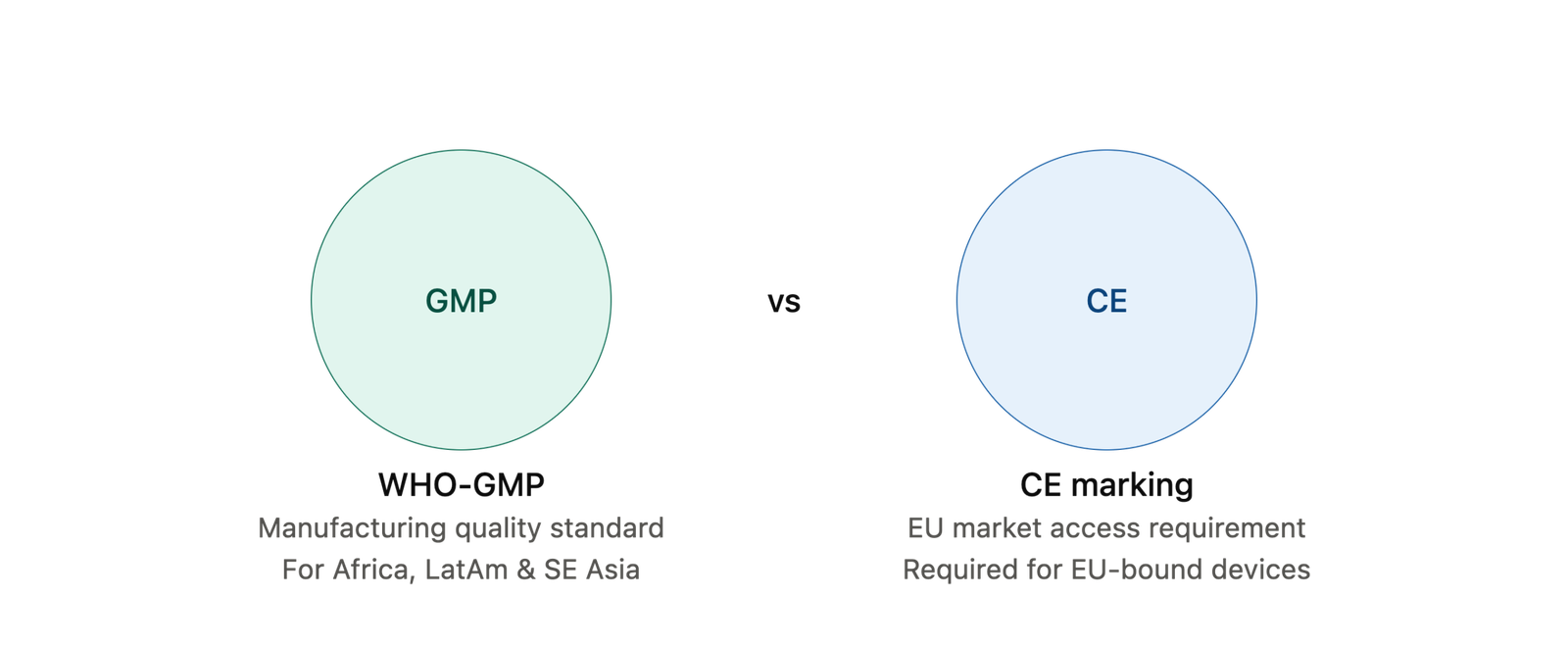
WHO-GMP (World Health Organization – Good Manufacturing Practices) is a manufacturing quality standard. It certifies how a product is made — the cleanliness of the facility, the consistency of the manufacturing process, the traceability of batches, and the controls in place to prevent contamination or error. It’s issued following an inspection of the manufacturing site itself.
CE marking, on the other hand, is a European Union regulatory approval. It certifies that a specific product meets the EU’s safety and performance requirements under the Medical Device Regulation (MDR) — and it’s a market access credential, not just a quality standard. Without it, a medical device legally cannot be sold in the EU.
The simplest way to think about it:
- WHO-GMP asks: “Was this made properly?”
- CE marking asks: “Is this specific product approved for the EU market?”
Why this distinction matters more than the certificates themselves
Here’s the part that trips up a lot of importers: CE marking applies to medical devices, not pharmaceuticals. Ophthalmic surgical knives, intraocular lenses, and ophthalmic viscosurgical devices are devices — CE (or the equivalent EU MDR pathway) is what’s relevant there. Eye drops and other pharmaceutical formulations follow a completely different regulatory track — national drug registration, marketing authorization, or a Certificate of Pharmaceutical Product (CPP) — where CE marking simply doesn’t apply at all.
This means the question “does my supplier have CE?” is often the wrong question to be asking about half of what you’re importing.
What most African and Southeast Asian markets actually require
This is the part that matters most for your day-to-day sourcing decisions. Many national drug and device regulatory authorities across Africa and Southeast Asia — including registration bodies in countries like the Philippines, Malaysia, Nigeria, and Kenya — accept WHO-GMP certification as sufficient for product registration, particularly for pharmaceuticals and lower-risk medical devices. CE marking is not a prerequisite in these markets; it’s an EU-specific requirement that many importers pay for unnecessarily, assuming it’s a universal “quality passport” when it isn’t.
In practice, this means:
- For eye drops, ointments, and other pharmaceutical products — WHO-GMP certification from the manufacturing facility is typically the key document your local registration authority will ask for, alongside a Certificate of Pharmaceutical Product and standard export documentation.
- For surgical instruments, IOLs, and viscoelastics — WHO-GMP plus ISO certification (ISO 13485 for devices specifically) is generally the credential set that carries weight, rather than CE.
When CE actually becomes relevant to you
There are two situations where CE marking does matter, even outside the EU:
- You’re re-exporting or supplying into a market that explicitly references CE or EU-equivalent standards in its own registration framework — some countries do this as a shortcut to avoid running their own full technical review.
- You want it as a trust signal for institutional buyers — some hospital tenders or NGO procurement processes list CE as a preferred (not always mandatory) credential, simply because it’s internationally recognized, even where it’s not a legal requirement.
Outside of these cases, insisting on CE-certified products for a Philippines or Nigeria-bound shipment is usually paying for a credential your registration authority never asked for.
What this means when you’re choosing a supplier
The practical takeaway: don’t judge a supplier purely on whether they hold CE certification. Ask instead:
- Is their manufacturing facility WHO-GMP certified, and is the certificate current?
- Do they also hold ISO 9001 / ISO 13485, which most registration authorities recognize alongside WHO-GMP?
- Can they provide a Free Sale Certificate and the specific documentation your country’s registration process requires?
- Do they understand the registration pathway for your market specifically — a supplier who’s registered products in the Philippines before will move faster than one who’s only ever exported to the EU?
A supplier with strong WHO-GMP credentials and real registration experience in your region is very often a better fit — and a more cost-effective one — than a supplier whose main selling point is a CE mark that your market doesn’t require.
The bottom line
WHO-GMP and CE aren’t competing certifications — they answer different questions for different markets. For most African and Southeast Asian importers, WHO-GMP (plus ISO where relevant) is the credential that actually clears your registration process. CE matters when you’re dealing with the EU specifically, or when an institutional buyer asks for it by name. Understanding this distinction — rather than treating both as interchangeable “quality stamps” — will save you time, money, and unnecessary back-and-forth with your regulatory authority.
Eyphora Lifescience Pvt. Ltd. manufactures and exports ophthalmic pharmaceuticals, surgical instruments, and intraocular lenses from WHO-GMP and ISO-certified facilities in India, with an active distributor network across 22+ countries. If you’re evaluating suppliers for your market’s specific registration requirements, get in touch with our export team — we can walk you through exactly what documentation your registration process will need. ophthalmic product registrationophthalmic product registrationophthalmic product registrationophthalmic product registrationophthalmic product registrationophthalmic product registrationophthalmic product registrationophthalmic product registrationophthalmic product registrationophthalmic product registration